How innovations work for regions: presentation of the IaaS4DR project at UzhNU
- Anastasia Kolomoiets
- May 11
- 3 min read
On Wednesday, January 28, the presentation of the international project "Innovation as a Service for Accelerated Innovation and Industrial Transition in Industrial, Rural and Remote Areas with Low Innovation Potential in the Danube Region (IaaS4DR)" took place, implemented within the framework of the Interreg Danube Region Programme. The initiative was aimed at strengthening the innovation potential of traditional industrial and backward rural areas of the Danube Region.
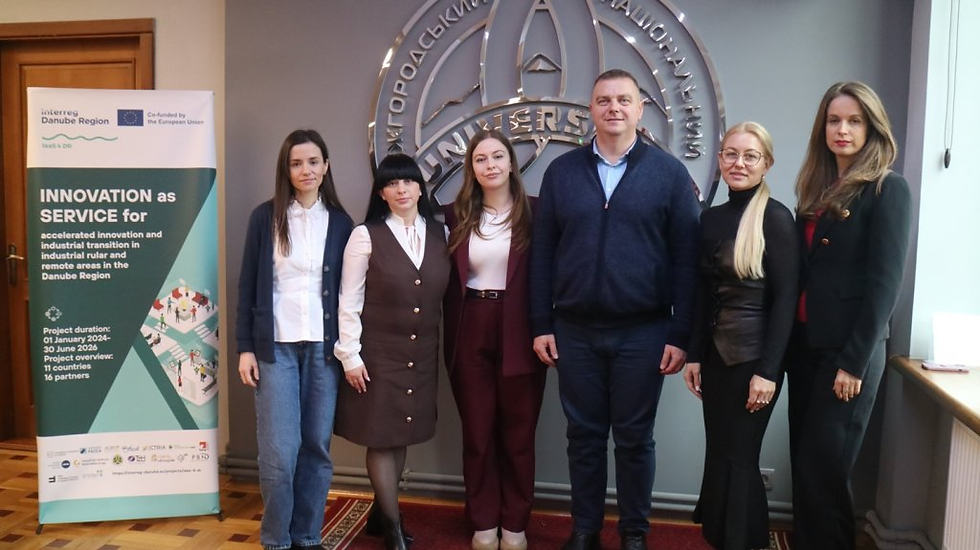
The project focuses on the development of new models of innovation support and technological transition based on the Innovation as a Service (IaaS) principle, which combine educational, coordination and expert services. The aim of the event was to discuss and implement approaches that would allow regions with low innovation capacity to form sustainable integrated innovation support systems, strengthen the potential of local specialists and promote the development of technologies and entrepreneurship.
Opening the event, Vice-Rector for Research Ivan Myronyuk noted that when talking about innovation, they usually mean the process of transferring knowledge to business with the support of the state, which performs a regulatory function. According to him, this approach is known in economic theory as the triple helix model of innovation, which involves science or the university, business as the main consumer of innovations, and the state as a policymaker.
At the same time, as the speaker emphasized, the IaaS4DR project is truly innovative, as it is based on the four-helix model. In it, the consumer of the relevant service is considered not as a passive element, but as an active participant in the transfer of innovations - it is he who determines needs, tests solutions and provides feedback.
"The university's task is usually to transfer knowledge and innovative technologies to business, after which business implements them and brings them to the market. In this project, a fourth component appears, which is already extremely important," he concluded, thanking the participants for their participation and wishing them fruitful cooperation and successful implementation of the project.
Project manager Vitaliy Serzhanov emphasized in his speech that the initiative involves 18 partners from different countries. The leading partner is the Technical University of the Czech Republic, and among the participants are universities, public organizations and innovation centers from Austria, Germany, the Netherlands, Croatia, Hungary and other European countries.
The main objective of the project, he said, is to study the problems of implementing innovations in the regions and the business environment, analyze structural changes, as well as study the challenges that have intensified in recent years, in particular after the start of a full-scale war. The initiative also explores the urban culture of innovation and issues of risk management.
The overall goal of the project is to create integrated innovation support services and form an innovation support center. Such a center will not be created directly in Uzhhorod within the framework of the program - it will be opened in Hungary, but Uzhhorod partners will join its work and contribute to the implementation of innovations in the region.
Special attention is paid to the online platform created within the project. It provides training programs for business representatives, entrepreneurs, government agencies and civil society and is designed to provide practical knowledge for implementing innovations. University employees, government representatives, business, business incubators and all interested parties will be able to participate in the training by registering on the platform.
The head of the research department also made a presentation. Kateryna Skubenych, who emphasized that the region is currently undergoing very rapid transformation, and changes are occurring virtually every day. That is why the issues raised within the IaaS4DR project are focused on supporting regions like ours, which are in a state of constant socio-economic transformation.
The speaker shared her experience of participating in a business trip to the city of Prijedor, which also experienced military action, noting that the challenges that this city faces today are largely consonant with those that will face Ukrainian regions during the period of post-war reconstruction. In her report, Kateryna Skubenych also focused on the problem of the low level of commercialization of innovations. Despite active discussions around innovations, transfer and entrepreneurship, the share of commercialized innovative developments remains insignificant, which requires overcoming systemic barriers and forming a risk culture in the economy. The shortage of qualified personnel was separately noted, which, according to forecasts, will only increase in the coming years.

At the end of the event, a lively and fruitful discussion took place with the participation of invited guests, representatives of the university community, business and expert circles. The participants exchanged views on practical aspects of the project implementation, opportunities for involving regions in innovative services, and also outlined potential areas of further cooperation. The discussion demonstrated the interest of the parties in developing joint initiatives and confirmed the relevance of the IaaS4DR project for strengthening the innovative potential of the region.
Anna Feltzan,
Information and Publishing Center



Comments