Why we are constantly craving sweets: how the microbiome controls your cravings and how to break this cycle


Have you promised yourself to give up sweets on Monday, but by Wednesday your hand is reaching for a chocolate bar or a bun? We tend to blame it on weak willpower, fatigue, or “bad genes.” However, modern science proves that the real mastermind behind our food cravings lies deep within us.
The secret lies in our gut—a superorgan often called our “second brain.” It’s where trillions of bacteria and fungi decide every day what you’ll eat for dinner.
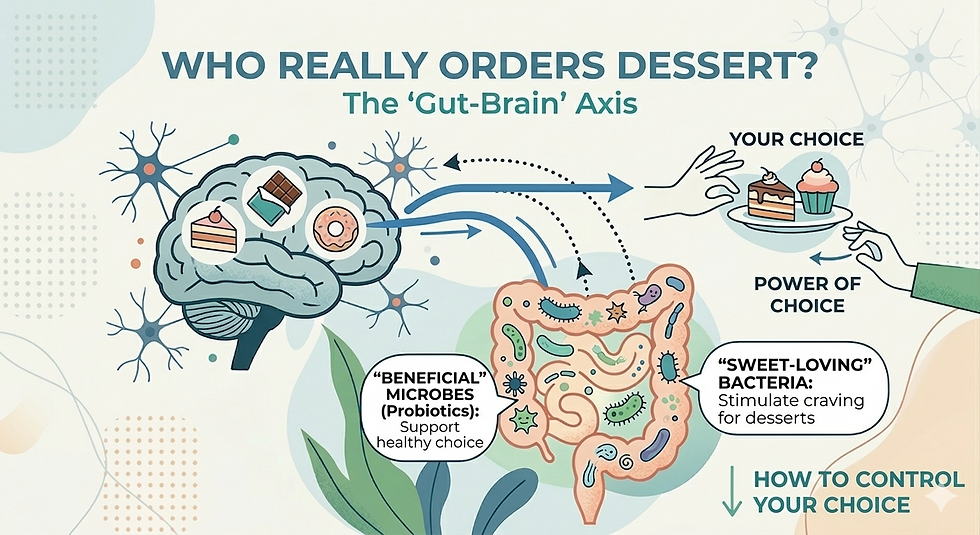
Who Really Orders Dessert? The Gut-Brain Axis
When we say we're feeding ourselves, we're actually feeding our own microorganisms. We think that wanting to eat cake is our conscious intuition. But intuitive eating is very often dictated by microbes.
The fact that the gut-brain axis communicates continuously is now well-established. Our bacteria produce short-chain fatty acids (such as butyrate) and neurotransmitters such as gamma-aminobutyric acid (GABA), which directly affect the brain and are involved in the production of serotonin.
The famous scientist Cohen Venema once very aptly noted: when a person has an alcohol addiction and is constantly drunk, then it is not only the person who is to blame, but also their bacteria, because they are constantly "drinking" them and demanding certain substances. The same applies to sugar addiction. Your microbiome literally makes you want sweets in order to feed certain groups of microorganisms.
Sugar Monsters: The Role of Yeast and Fungi
Why does the microbiome crave sugar and simple carbohydrates? The main culprits of irresistible cravings for sweets are often yeast-like fungi (for example, Candida albicans ), which begin to multiply uncontrollably in the intestines after stress, poor nutrition, or taking antibiotics.
Those who bake bread and use yeast dough know that yeast is in dire need of simple carbohydrates during the growth process. That is why they send signals to the brain and demand them from our body. Our beneficial intestinal bacteria do not like sweets or fats, they need fiber. But fungi love white bread, pasta and sweets, because they are rich in simple sugars.
Therefore, with an excessive growth of pathogenic flora, the craving for sweets is physiologically justified - your "internal inhabitants" simply demand food.
Stress as a trigger
Another powerful factor that makes us eat sweets is stress. Renowned neuroscientist Robert Sapolsky explains: when we are in a state of chronic stress or we feel that no one loves us, we start to eat sweets uncontrollably.
Stress literally shuts down the normal processes of digestion and regeneration in the gastrointestinal tract. This leads to an imbalance of microflora, which, in turn, increases anxiety again. A vicious cycle arises, which can only be broken through targeted restoration of the microbiome.

How to overcome cravings for sweets? 4 scientific steps
Forcing yourself to endure through willpower is like fighting against windmills. To break free from sugar addiction, you need to reprogram your microbiome.
1. Stop feeding the fungi
To combat a yeast infection, you will have to stop feeding them. This means temporarily but strictly avoiding sweets, sweet fruits, juices, white pastries and pasta, as well as dairy products (due to lactose - milk sugar). Also avoid artificial sweeteners (such as aspartame): they contain no calories, but stimulate the growth of unwanted pathogenic enterobacteria.
2. Feed the “right” bacteria with fiber
Your beneficial bacteria (especially bifidobacteria) feed on fiber. Eat more legumes, beans, and vegetables. But remember an important rule: if your diet previously consisted of ultra-processed foods, you need to introduce new beneficial foods (fiber) very gently and gradually (in microdoses). Otherwise, the microbes will not have time to adapt, and you will get bloating and abdominal pain.
3. Don’t take probiotics blindly
The worst thing you can do is go to the pharmacy and buy a drug that contains 36 different strains of bacteria. Professor Nadiya Boyko compares this to a closed club: your own microbes are already sitting in their places, and you drive a crowd of strangers there. This is bad for everyone, and you risk destroying the remnants of your own unique microflora. Correction should be carried out with targeted pharmabiotics (drugs with proven effects), selected individually.
4. Make a genetic passport of your gut
The most effective way is to conduct an in-depth study (sequencing) of your gut microbiome . It will show you which bacteria you are lacking and which have grown beyond measure. Based on this data, Ediens’ special IT algorithms develop a personalized nutrition plan that uses food as medicine to specifically restore your healthy balance.
Remember: you have the microbiome you deserve with your lifestyle. Stop blaming yourself for a crappy diet — start feeding your good bacteria the right way, and they’ll give up sugar on their own!
Follow us on social media to follow the latest news here 💜:
Website: www.ediens.me
Instagram: www.instagram.com/ediens_official
TikTok: www.tiktok.com/@ediens_official


Comments