After vacation, the intestines "protest": how to return to your usual diet without drastic restrictions


Introduction: The phenomenon of “post-vacation GI syndrome” in the light of 4P medicine
For most people, vacation is a long-awaited time of relaxation, change of scenery and gastronomic pleasure. We happily taste exotic dishes, enjoy local cuisine, allow ourselves desserts, alcoholic cocktails and late dinners, often neglecting the usual sleep and wakefulness regime. However, returning to the daily work routine is very often overshadowed by physiological discomfort. Instead of the expected surge of strength, a person is faced with flatulence, bloating, heaviness, bowel disorders (constipation or diarrhea), chronic fatigue and irritability.
In the medical literature, this condition is increasingly described as post-vacation GI syndrome , which is a classic manifestation of acute transient intestinal dysbiosis. In an attempt to quickly get back in shape and get rid of discomfort, patients often make a serious physiological mistake - resorting to aggressive restrictive diets, juice "detoxes" or abrupt starvation.
Modern molecular microbiology and the concept of 4P medicine (preventive, predictive, personalized, and patient-centered) emphasize that any sharp restrictions after a period of food overload are an additional stress factor that only exacerbates damage to the intestinal mucosa.
True recovery requires a systemic, scientifically based approach. In this scientific article, we will analyze the pathophysiology of the holiday shift of the microbiota, prove the harm of “extreme cleanses”, and present advanced biotechnological solutions from Ediens — molecular research of the microbiome with a personalized recovery protocol and a new generation targeted pharmabiotic “My Second Brain” .
1. Pathophysiology of the holiday shift: how the microbiome changes
The gut microbiome is a complex ecosystem consisting of trillions of microorganisms, with a combined genome hundreds of times larger than the human genome. This “superorgan” is sensitive to any environmental changes, acting as a key mediator between external epigenetic factors and our physiological systems.
During vacation, a number of destabilizing factors simultaneously act on the microbiome:
A. Changing the chemical profile of the diet
The predominance of easily digestible carbohydrates, saturated fats and alcohol stimulates the rapid reproduction of opportunistic microorganisms (in particular, representatives of the Enterobacteriaceae family and yeasts of the genus Candida ). These microbes use simple sugars as an ideal substrate for fermentation, releasing large amounts of gases (methane, hydrogen) and acidic metabolites.
At the same time, the lack of coarse plant fiber in the holiday menu leads to the depletion of populations of beneficial commensal bacteria ( Akkermansia muciniphila , Faecalibacterium prausnitzii , and Bifidobacterium spp. ).
B. Metabolic endotoxemia and barrier disruption
Beneficial bacteria typically break down complex dietary fibers to release short-chain fatty acids (SCFAs)—butyrate, acetate, and propionate. Butyrate is the main source of energy for intestinal epithelial cells (enterocytes) and stimulates the production of protective mucin mucus.
When the level of CLFA drops, the protective mucous layer thins. Bacteria, deprived of fiber from the outside, begin to degrade (break down) endogenous mucin for their own survival. This damages the tight junctions between epithelial cells (leaky gut syndrome).
Components of the walls of opportunistic bacteria — lipopolysaccharides (LPS) — enter the bloodstream, causing subclinical chronic low-grade inflammation. This inflammation damages receptors, causes spasms, and disrupts intestinal motility.
B. Circadian rhythm stress and climatic factors
Changing time zones, long flights and irregular sleep disrupt the biorhythms not only of the brain, but also of the microflora itself. Intestinal bacteria have their own circadian oscillations of activity. Disruption of these rhythms reduces the colonization resistance of the microbiome, facilitating the reproduction of transient (alien) pathogenic strains that enter with local water or food.

2. Why drastic restrictions and “detox” after vacation is a scientific mistake
Faced with discomfort and a feeling of being "slagged", people often resort to radical cleansing procedures: drinking exclusively vegetable juices (smoothies), mono-diets, or complete starvation. From the point of view of molecular physiology, such behavior is extremely dangerous:
Additional systemic stress: Fasting activates the sympathoadrenal system and dramatically increases cortisol levels. Chronically high cortisol completely blocks the physiological repair (restoration) processes of damaged gastrointestinal mucosa. The body goes into a "survival" mode, in which digestive function is suppressed.
Osmotic shock and fermentation from juices: Freshly squeezed juices are devoid of structured dietary fiber, but contain an extremely high concentration of free fructose. Once in the inflamed intestine, fructose does not have time to be absorbed in the small intestine and passes through into the large intestine. There, it causes osmotic shock in bacteria and becomes fuel for violent yeast fermentation, increasing flatulence and pain.
Fiber collapse: Trying to abruptly switch to a large amount of raw vegetables and greens (“salad detoxes”) overloads the intestines, which have lost their enzymatic capacity due to vacation dysbiosis. The body simply does not have the necessary number of commensal bacteria to break down coarse cellulose, which leads to mechanical irritation of the intestinal wall, increased inflammation and chronic spasm.
3. Step 1. Molecular diagnostics and Personal recovery protocol (Gut Reset)
In order to restore gut health and comfort without violence to the body, it is necessary to act with precision. The first and most important step is to undergo a metagenomic study of the microbiome from Ediens .
What does microbiome research reveal?
Unlike outdated and uninformative bacterial cultures for dysbacteriosis, which detect only a limited number of aerobic bacteria capable of growing on artificial media, Ediens uses advanced next-generation sequencing (NGS) 16S rRNA technology.
This analysis allows you to fully decipher the DNA profile of your intestinal microflora down to the species level. The study determines:
Biodiversity index (Shannon index) and bacterial evenness (Pilow index): key indicators of intestinal ecosystem stability.
Firmicutes/Bacteroidetes ratio: a marker responsible for the tendency to gain weight and insulin resistance.
Concentration of protective and anti-inflammatory species ( Akkermansia muciniphila , Faecalibacterium prausnitzii ).
The level of opportunistic bacteria and the presence of inflammatory markers.
EdiensUniCode Algorithm and Personal Protocol
The obtained DNA test results are uploaded to the unique Ediens information system. Using the proprietary mathematical algorithm EdiensUniCode (BioQuantum) , created on the basis of 37 years of fundamental scientific research, the system compares the genetic passport of your microbiota, current blood biomarkers and data from your detailed medical questionnaire (complaints, lifestyle, food allergies).
The algorithm calculates individual Shift deviations of your microbiome from the norm and forms an individual recovery program — Microbiome Nutrition Plan (Gut Reset) .
This is a personalized protocol divided into 4 sequential, gentle phases. The program does not artificially restrict calories, but selects specific traditional local and fermented foods, where plant ingredients act as highly precise prebiotics specifically for your deficient bacteria. The plan allows you to smoothly, step by step, rebuild the intestinal barrier, normalize pH and restore comfort without stress for the body.
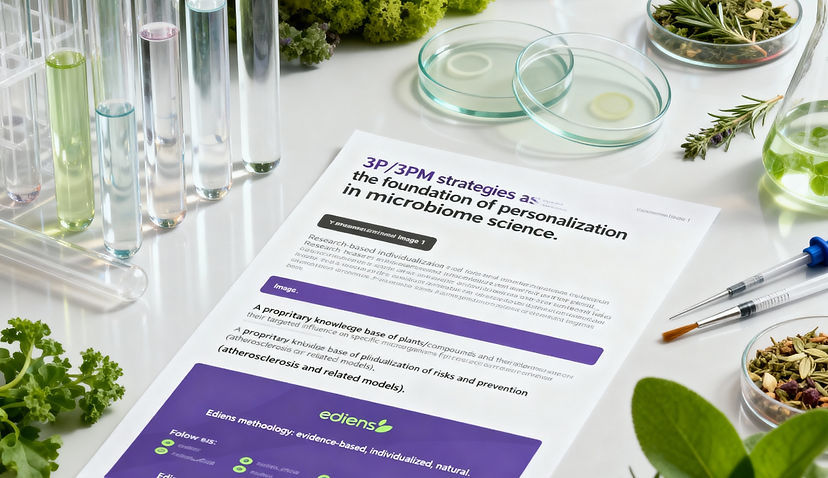
4. Step 2. Targeted restoration with pharmabiotic “My second brain. Gut microbiome”
In parallel with the start of a gentle diet therapy according to a personal protocol, targeted support with live beneficial microorganisms is necessary to quickly extinguish inflammation and restore the ecological balance of the intestine. For this, Ediens has developed an innovative niche pharmabiotic of a new generation - " My Second Brain. Gut Microbiome " .
Unique composition and synergy of strains
Pharmabiotic is available in convenient portioned sachets with lyophilized powder. Each sachet contains a precisely calibrated, clinically tested composition of live bacteria selected based on the results of studies of stratified groups of patients with chronic inflammatory bowel diseases and IBS:
Lactobacillus bulgaricus A6
Lactobacillus bulgaricus A22
Lactobacillus bulgaricus S6
Lactobacillus rhamnosus S25
The total number of viable cells in each sachet is not less than $1\cdot10^9$ CFU/g .
Mechanism of therapeutic action
Unlike standard pharmacy probiotics, the strains in the composition of the drug "My Second Brain" act as powerful biological agents with a known, scientifically proven effect:
Rapid elimination of flatulence and bloating: Lactobacilli actively suppress the vital activity of gas-forming and putrefactive microflora in the colon. They normalize the pH of the environment, creating conditions under which opportunistic microbes lose their ability to reproduce, quickly stopping the processes of fermentation and bloating.
Mucosal healing: L. rhamnosus S25 stimulates the repair of intestinal epithelial tight junctions and enhances the synthesis of secretory immunoglobulin A (sIgA), which is the first line of immune defense in our gut. This stops metabolic endotoxemia and systemic inflammation.
Regulation of motility: The drug restores normal sensitivity of the intestinal wall, gently eliminating the phenomena of both constipation and diarrhea, returning physiological ease and regularity of defecation.
Weight correction: The product helps restore the balance of microflora, which contributes to the normalization of metabolism and helps control appetite (preventing cravings for sweets, which often occur with dysbiosis).
Conclusions : Ediens Comfort Recovery Formula
Returning from vacation should not be accompanied by intestinal distress or debilitating restrictions. To regain health and ease, modern science recommends following the 3P medicine algorithm:
Diagnose the cause: Take a high-tech microbiome genetic test from Ediens.
Get a Personal Protocol: Start an individual Biocode4U nutrition and recovery program calculated by your EdiensUniCode algorithm.
Connect targeted therapy: Take a 14-day course of taking the niche pharmabiotic "My Second Brain. Gut Microbiome" to instantly relieve inflammation, eliminate flatulence, and populate the intestines with friendly strains.
Taking care of your microbiome is an investment in your immunity, good mood and active longevity. Restore your inner balance together with Ediens proven technologies!
Short questions and answers (Q&A)
1. Why do we often experience severe bloating and flatulence after a vacation? Answer: During vacation, we often change our diet, consuming more simple carbohydrates, fats, and alcohol, while lacking fiber. This leads to the death of beneficial bacteria and the rapid proliferation of opportunistic strains and yeasts. The latter actively ferment sugars with the release of large amounts of gases, which causes heaviness, cramps, and bloating.
2. Why can't you go on a "detox" or fasting diet to quickly cleanse your intestines? Answer: Fasting sharply increases the level of the stress hormone cortisol, which completely blocks the recovery of the damaged intestinal mucosa. Drinking juices, on the other hand, gives a shock dose of free fructose, which does not have time to be absorbed, enters the colon and causes acute fermentation and increased flatulence. Recovery should be smooth and balanced.
3. How does the Ediens microbiome genetic test differ from a conventional dysbiosis test? Answer: Conventional culture only detects a tiny fraction of bacteria that can grow in a Petri dish. The Ediens microbiome genetic test uses next-generation sequencing (NGS) to analyze the DNA of all intestinal microorganisms. This allows you to accurately determine the biodiversity index, bacterial ratios, and the deficiency of protective strains, and based on this, develop an accurate individual recovery protocol.
4. How exactly does the pharmabiotic "My Second Brain" help restore intestinal function after vacation? Answer: The drug "My Second Brain" contains a unique patented composition of live strains of Lactobacillus bulgaricus and Lactobacillus rhamnosus S25 . They quickly suppress pathogenic flora, stop the processes of putrefaction and fermentation, eliminate flatulence, relieve inflammation of the mucous membrane and normalize peristalsis, returning comfort and ease of digestion.
Follow us on social media to follow the latest news here 💜:
Website: www.ediens.me
LinkedIn: https://www.linkedin.com/company/ediens/
Instagram: www.instagram.com/ediens_official
TikTok: www.tiktok.com/@ediens_official


Comments