Rosacea and couperose: why lasers and ointments only give a temporary effect and how to find the root of the problem in the gastrointestinal tract


Rosacea and couperose are chronic skin diseases accompanied by persistent redness, dilated blood vessels, and inflammatory rashes on the face. For years, patients visit cosmetologists and dermatologists, spending huge amounts of money on hardware procedures (lasers, phototherapy) and expensive ointments. However, very often the disease returns again. Modern evidence-based microbiomics states: it is impossible to cure the skin by affecting only the surface. The real control panel for blood vessels and the level of inflammation on the face is located deep inside - in our intestines. This article reveals the mechanisms of the gut-skin axis and offers an algorithm for precision correction using pharmabiotics.
PART I. The Paradox of Dermatology: “What’s My Gut Got to Do With It?”
Very often, integrative medicine doctors face skepticism from patients. As dermatologist and nutritionist Kateryna Doroshenko notes: "Sometimes I encounter patients who say: 'What's my gut doing here, what's my gynecology doing here? I came here, so do something here (on my face)'" .
But the truth is that our body is a single, inseparable ecosystem. We must understand that the client is one, he has one body, and any intervention in the intestines will definitely affect the skin, and vaginal or oral health.
Anatomically, the skin is the largest organ of our body and a kind of "mirror" of the internal state. If the balance of bacteria in the gastrointestinal tract is disturbed (dysbiosis occurs), the intestinal walls become permeable (leaky gut syndrome). Toxins and pathogenic metabolites enter the bloodstream, causing systemic inflammation. Facial vessels (especially in couperose and rosacea) react extremely sensitively to these inflammatory markers: they lose elasticity, expand and become fragile. This is how a systemic intestinal problem manifests itself on your face.

PART II. The Gut-Skin Axis in a Real Clinical Case
To understand exactly how bacteria destroy facial vessels, let's consider an illustrative clinical case from Ediens.
A woman who had pronounced couperose on her face and at the same time complained of irritable bowel syndrome (IBS) turned to specialists. Instead of prescribing another cream, scientists approached the problem comprehensively and personalizedly, studying two microbiotas at once - skin and intestinal. Because it is impossible to treat one link of the gut-skin axis while ignoring the other.
What did the in-depth diagnostics (Omics profile) show?
On the skin: Excessive, aggressive growth of Staphylococcus epidermidis and fecal enterococcus ( Enterococcus faecalis ) was detected . They provoked local inflammation, redness and destruction of blood vessels (manifestations of couperose).
In the intestines: The analysis showed a serious imbalance. An excess of opportunistic flora was detected: Escherichia coli , enterococcus, and pseudomonas (cyanobacterium). At the same time, a critical decrease in the level of beneficial defenses - bifidobacteria and lactobacilli - was recorded.
This case illustrates perfectly: an imbalance in the microbiota in the gastrointestinal tract weakened systemic immunity, which allowed pathogens to multiply unhindered on the skin, destroying capillaries.
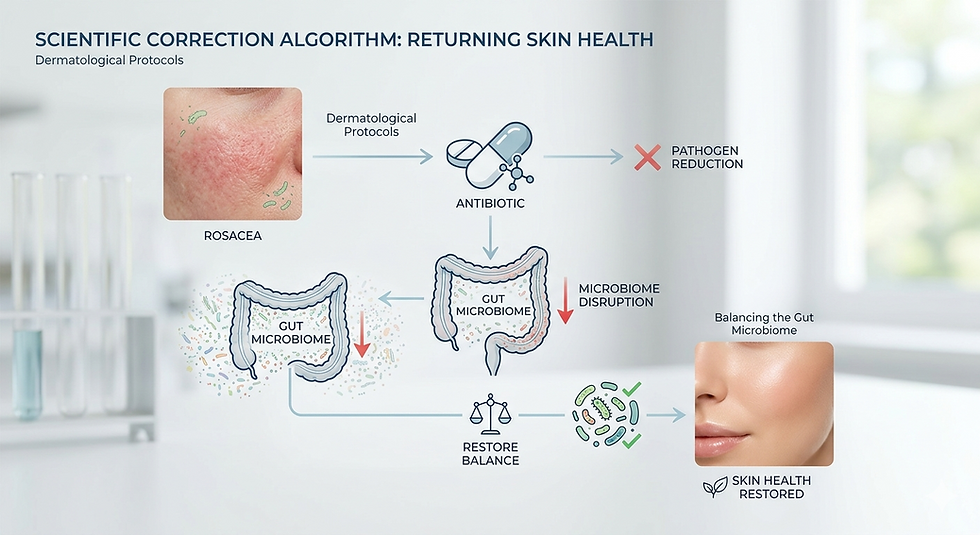
PART III. The scientific correction algorithm: how to restore skin health
Classic dermatological protocols often use antibiotics (e.g. systemic tetracyclines) to treat severe rosacea. However, by killing bacteria on the skin, antibiotics further “burn out” the already depleted gut microflora. A vicious cycle ensues: the facial inflammation temporarily subsides, but the gut is destroyed, and after the drug is discontinued, rosacea returns with double the force.
Modern 4P medicine (predictive, preventive, personalized) offers a fundamentally different, safe algorithm:
Step 1. Accurate diagnosis of the pathogen
It is necessary to conduct an in-depth study (culturomics and NGS genetic analysis) of the intestinal microbiota, and ideally - scrapings from the affected areas of the skin. This allows us to identify specific "enemies" that cause inflammation of facial capillaries, rather than acting randomly.
After diagnosis, specialists carry out a personalized selection of probiotic strains (pharmabiotics). The main rule of modern science: the selected drug should specifically inhibit (suppress) those pathogenic bacteria that caused inflammation, but at the same time be guaranteed not to harm the patient's own beneficial microorganisms. In the above-mentioned clinical case, the patient was selected individual pharmabiotics for the intestines, and for the skin, the clinically tested drug SkinRen was additionally used , which coped with the found conditionally pathogenic microorganisms as effectively as possible.
Step 3. System result
Treatment "from the inside" gives a comprehensive effect. After completing the course, the patient noted not only the visual disappearance of the couperose mesh and redness on the face, but also a significant improvement in her general well-being and the disappearance of discomfort (IBS) in the gastrointestinal tract.
CONCLUSION
Skin is just the tip of the iceberg. Rosacea and couperose signal that your body is in a state of systemic dyshomeostasis and chronic inflammation. Stop fighting your body only with aggressive cosmetics and antibiotics. Do a deep analysis of your gut microbiome, support your beneficial flora with the right pharmabiotics and personalized nutrition - and your skin will thank you with a clean, healthy appearance without relapses.
🔬 CLINICAL Q&A: 4 questions about rosacea, couperose and the microbiome
1. Why does laser vascular removal (for couperose) often only give a temporary effect, and the vessels appear again?
Laser coagulation acts solely on the effect - it "seals" the already dilated vessel. However, it does not in any way eliminate the root cause of the problem: systemic inflammation and imbalance of the gut-skin axis. If pathogens continue to multiply in the intestines (for example, Pseudomonas aeruginosa or an excess of enterococcus), they will continue to release toxins into the blood, which will again destroy the walls of new capillaries on your face.
2. What bacteria can provoke the appearance of couperose and redness on the skin?
According to clinical studies, inflammation and redness are often provoked by excessive aggressive growth of Staphylococcus epidermidis and Enterococcus faecalis directly on the skin, which occurs against the background of depletion of beneficial bifido- and lactobacteria in the intestines and an excess of E. coli or pseudomonas there.
3. Can stress and nervous tension cause rosacea to flare up?
Yes, absolutely. There is a direct connection between the gut and the brain. Chronic stress "turns off" normal digestion, changes the acidity of the stomach and leads to the rapid reproduction of pathogenic flora in the intestines. This causes a powerful inflammatory response throughout the body. In addition, stress hormones (cortisol) contribute to the expansion of blood vessels, which instantly makes the manifestations of rosacea and couperose more vivid. Therefore, treatment should also include anti-stress correction of the intestinal microbiome.
4. Can I just buy a drug with 30 strains of probiotics at the pharmacy to improve my skin condition?
Modern science does not recommend taking multi-strain probiotics “blindly”. Your intestines and skin are closed ecosystems. By throwing dozens of unknown strains there without analysis, you can suppress the remnants of your own unique protective microflora. Correction should be exclusively targeted (directed): first diagnostics to find the pathogen, and then - the selection of an individual pharmabiotic that will destroy this particular pathogen, preserving your beneficial bacteria.
Follow us on social media to follow the latest news here 💜:
Website: www.ediens.me
LinkedIn: www.linkedin.com/ediens
Instagram: www.instagram.com/ediens_official
TikTok: www.tiktok.com/@ediens_official


Comments