Secrets of Ukrainian traditional fermented dishes: how ancestral food becomes medicine for your gut


ABSTRACT: Today, the whole world is fascinated by fermented foods: Hollywood stars drink kombucha, and nutritionists advise kimchi and tempeh. However, we often forget that Ukrainian traditional cuisine has had powerful tools for maintaining health for centuries — its own fermented dishes. From ordinary sauerkraut to unique drinks based on the milk of a gray Ukrainian cow and herbs. Modern evidence-based 4P medicine and microbiome science prove: our local fermented food is not just a gastronomic heritage, it is a high-tech complex of prebiotics and probiotics, ideally adapted to our genetics. In this article, we will analyze how Ukrainian traditional products work at the cellular level and how modern algorithms turn them into personalized medicines.
PART I. Biocultural diversity: what does Ukraine's "Ark of Taste" hide?
Ukrainian cuisine is a multifaceted and complex ecosystem, shaped by diverse natural conditions: from the Carpathian Mountains to the Luhansk steppes and the Black Sea coast. Ethnographic groups - Hutsuls, Boykas, Lemkos, Polishchuks - have created their authentic recipes for centuries that helped them survive, maintain strong immunity and high energy levels.
To preserve these unique products, the University of Gastronomic Sciences, together with the international organization Slow Food, compiled the catalog "Ark of Taste of Ukraine". This project proves that our gastronomic heritage is a natural science and medical tool. Behind every ancient recipe for stew, mushroom abalone or kvass there is a deep biological logic that modern science is only now beginning to decipher.

PART II. The Anatomy of Fermentation: Why is fermented better than fresh?
What makes fermented foods so special for our digestive tract? The fermentation process is essentially the “pre-digestion” of food by beneficial microorganisms (bacteria and yeast).
Modern evidence-based microbiomics explains the effectiveness of such products by a triple effect:
Prebiotics: Vegetables (cabbage, beets, carrots, radishes) contain a lot of fiber. Dietary fiber is the main source of energy for our intestinal microbiota.
Probiotics (microbial starters): During fermentation, beneficial strains of microorganisms, mainly lactobacilli, multiply. They actively crowd out pathogenic microbes.
Postbiotics (metabolites): Bacteria convert fiber into valuable substances — such as vitamins and short-chain fatty acids (butyrate, acetate, propionate) — that reduce inflammation in the gut, lower cholesterol levels, and lower blood pressure. The nutritional value of the ingredients is greatly enhanced by fermentation, making the food much easier to digest.
PART III. Ukrainian superfoods: from cabbage to healing potions
Let's look at specific examples of Ukrainian traditional fermented foods that are real "medicines" for the intestines.
1. Sauerkraut is the king of our microbiome
All fermented vegetables are great for your gut, but sauerkraut is the clear winner. It’s incredibly rich in vitamins C and K, iron, and fiber. It’s fermented with powerful lactobacilli, which, once in your gastrointestinal tract, help regulate your immune response and improve digestion.
2. Variety of pickled vegetables
Diversity is critical for a healthy microbiome. Evidence-based medicine recommends eating not only cabbage, but also sauerkraut, radishes, and beets. These local foods (as well as leafy greens and asparagus) contain the type of sugars and inulin that selectively stimulate the growth of healthy gut bacteria.
3. Ancient Healing Drinks (Recipe from the "Ark of Taste")
Our ancestors created real functional drinks. One of the documented recipes demonstrates a deep understanding of the synergy of ingredients: natural honey is diluted in water (1:3), sage flowers and elecampane roots (devyatisil) are added. Sorrel juice is added to regulate acidity, and to soften the taste and enhance the healing effect of herbs, fresh milk of the indigenous Ukrainian gray breed of cows is added. This mixture is fermented in an open vat at a temperature of 20-25 °C for 7-10 days, after which the drink matures in linden barrels. Such a product is a powerful synbiotic containing prebiotics from elecampane roots and probiotics from raw milk.
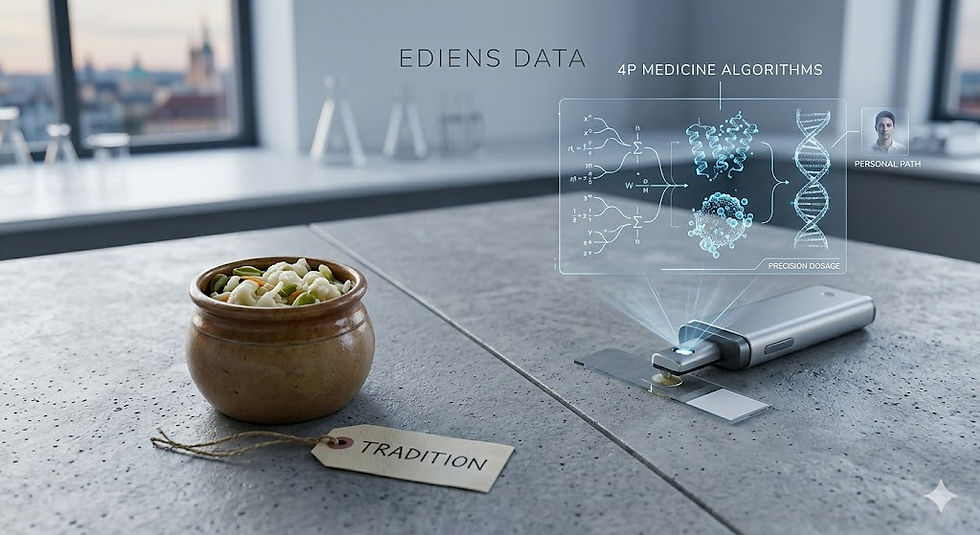
PART IV. How 4P Medicine Transforms Traditions into Modern Algorithms
Modern European and Ukrainian science (in particular, the Ediens company) does not simply advise “eating fermented foods.” It translates traditional knowledge to the level of mathematical IT algorithms and precision (accurate) medicine.
Personalized nutrition based on local products
Universal diets do not work, because each microbiome is unique. The modern approach involves creating an individualized nutrition plan based on an accurate genetic analysis of the intestinal microbiome. This algorithm significantly uses traditional local, including fermented foods and drinks. The plant ingredients in them act as prebiotics, and the microbial starters of fermented foods enhance this effect as probiotic agents with a known, proven effectiveness. This helps with atherosclerosis, obesity, type II diabetes and other non-communicable diseases.
From a barrel of cabbage to innovative pharmabiotics
Scientists went even further: they studied traditional fermented products, isolated the strongest microorganisms from them and created patented therapeutic compositions based on them. For example, an innovative process for obtaining the composition was developed, where homogenized pumpkin and carrot fruits (rich in pectin) are used as natural prebiotics, to which specially selected probiotic strains of lactobacilli are added: Lactobacillus plantarum IMB B-7414 and Lactobacillus casei IMB B-7412. This complex has a pronounced synergistic effect: it is able to specifically correct the intestinal microbiota, suppressing opportunistic microorganisms (even Staphylococcus aureus) and supporting the patient's own beneficial microflora.
CONCLUSION
Ukrainian traditional fermented food is not just a tasty addition to the diet. It is a biological health code genetically native to us. Our ancestors, consuming fermented vegetables, roots and fermented dairy products, intuitively carried out disease prevention. Today, evidence-based medicine allows us to do this consciously: analyze our microbiome and, with the help of algorithms and clinically proven pharmabiotics, apply these centuries-old secrets for active longevity, treatment of chronic inflammation and preservation of mental health.
❓ Questions and Answers (Q&A)
1. Why are traditional Ukrainian fermented foods (sauerkraut, beets) more beneficial for us than exotic superfoods?
This is due to the biocultural and genetic adaptation of our body. Our microbiome has been shaped over centuries by local food and local bacteria. Therefore, traditional fermented foods (where plant ingredients act as prebiotics and local microbial starters act as probiotics) are recognized best by our body and provide the predicted therapeutic effect.
2. Do beneficial bacteria from pickled vegetables die in the acidic environment of the stomach?
Not completely. Although gastric juice is an aggressive environment, some of the bacteria from fermented vegetables successfully pass this barrier and enter the intestines, where they begin their beneficial effects. In addition, modern innovative pharmabiotics based on such strains (for example, compositions with Lactobacillus plantarum ) are specially developed with high stability and concentration (not less than 108 CFU) to ensure that they reach the zone of action.
3. Can everyone eat sauerkraut or drink kefir without restrictions?
No, the approach should be individual. If a person has severe dysbiosis, overgrowth of opportunistic flora, or bacterial overgrowth syndrome (BOS), uncontrolled consumption of fermented foods can cause severe fermentation and bloating. Therefore, modern medicine advises selecting such products based on the results of genetic analysis of the microbiome using special algorithms.
4. How do modern scientists use the knowledge of traditional fermentation to create medicines (pharmabiotics)? Scientists isolate the strongest microorganisms (for example, strains of lactobacilli L. plantarum or L. casei ) from traditional fermented foods or a healthy microbiome. They then combine these live bacteria with natural prebiotics (for example, pectin from carrots and pumpkin), creating patented therapeutic complexes. Such drugs specifically suppress pathogens and restore the microbiome, with proven clinical efficacy.
Follow us on social media to follow the latest news here 💜:
Website: www.ediens.me
LinkedIn: www.linkedin.com/ediens
Instagram: www.instagram.com/ediens_official
TikTok: www.tiktok.com/@ediens_official


Comments